
Borrowing the Vaccine Cold Chain: Solar Direct-Drive and Ice-Lined Refrigerators
Immunization programmes already solved the problem of holding a temperature band in a 40 °C room on a grid that fails — and they publish the test figures to prove it.
For a +2 °C to +8 °C storage requirement at a hot site on a failing grid, a WHO-prequalified vaccine refrigerator is usually the better-engineered choice than a laboratory or pharmacy fridge at a similar price — and the reason is the test regime, not the badge. Every appliance in the WHO PQS E003 category is type-tested at a steady +43 °C ambient and across a +43 °C / +25 °C day–night cycling range, and is published with a measured reserve figure rather than a marketing claim [1][2]. Two constraints decide whether you can actually use one: it holds a single narrow band, and its thermostat is deliberately built so that nobody on site can change that band.
That trade is worth understanding precisely, because immunization programmes have already spent two decades solving the exact operating problem this region presents: a hot room, an intermittent supply, no technician within a day’s drive, and an obligation to prove afterwards what the contents actually experienced. A systematic review of facility surveys across sub-Saharan Africa found that 26% of health facilities reported no access to electricity at all, and that among the eight countries with reliability data, an average of 28% described their supply as reliable [9]. Those surveys are more than a decade old now, but the equipment class built for that constraint is still the most rigorously specified cold storage in the region.
What "solar direct-drive" and "ice-lined" actually mean
A solar direct-drive (SDD) appliance runs its compressor straight from a photovoltaic array with no battery in the circuit. Energy is banked as cold — as ice, water or phase-change material around the storage compartment — rather than as charge. The design choice was deliberate: battery-backed solar refrigerators of the 1990s and 2000s failed predominantly through battery replacement that never happened, so the category was re-specified around a storage medium that cannot be stolen, cannot be depleted by a technician borrowing it, and does not need replacing on a three-year cycle [6][7][8]. The published performance figure for an SDD unit is autonomy: the hours it can hold the load in band under low solar radiation, such as consecutive overcast days [1].
The mains-powered counterpart is the ice-lined refrigerator, built around a jacket of water containers that freeze while power is available and then absorb heat while it is not. Its published figure is holdover time. The PQS category covering these was historically titled for ice-lined refrigerators; the current revision is titled by power condition instead — "intermittent mains powered, compression cycle" — because the thermal reserve is no longer always a water jacket [2]. That specification names its intended sites explicitly: places with roughly eight to twenty hours of reliable electricity in a typical day, or fewer than eight, with some technologies suitable for as little as four hours of supply per day [2].
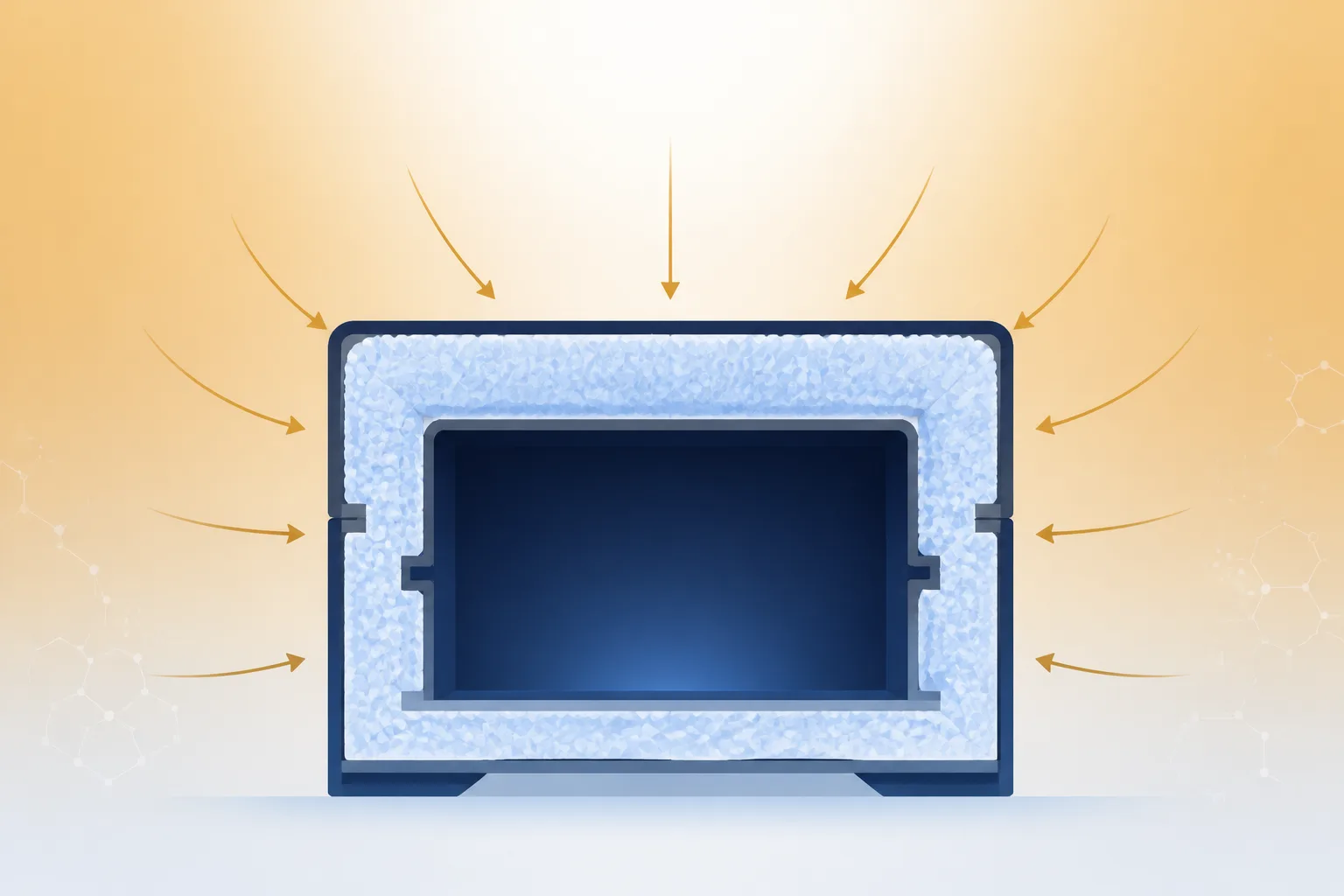
Both categories sit under the same prequalification scheme, and the resulting catalogue is public: every listed model carries its measured reserve figure, its climate zone rating, its freeze protection grade and its net storage capacity in litres [3]. That catalogue is the single most useful procurement document in this whole area, and almost nobody outside immunization supply chains reads it.
Holdover, autonomy and climate zone: the three numbers on the label
Holdover time has a formal definition worth quoting closely: the time in hours during which all points in the storage compartment remain between +2 °C and +8 °C, at the maximum ambient temperature of the zone for which the appliance is rated, after the power supply has been disconnected [2]. Three things are load-bearing in that sentence. It is every point in the compartment, not the warmest sensor. It is measured at the top of the rated ambient band, so a hot-zone figure was obtained at +43 °C. And it starts from a fully cooled, closed appliance — a unit that has not had time to build its ice reserve has no holdover at all.
- Short holdover: 20 to 48 hours. Covers a nightly outage and a bad day, not a weekend fault [2].
- Medium holdover: 48 to 120 hours. Covers a transformer failure that waits for a parts run.
- Long holdover: over 120 hours. Rare, expensive, and the only band that survives a week-long fault unattended [2].
For solar direct-drive units the equivalent floor is set in days rather than hours. Every SDD refrigerator must prequalify with at least three days of autonomy, measured at the minimum solar radiation reference period of 3.5 kWh/m²/day and under hot-zone conditions [1]. SDD water-pack freezers are held to a far weaker requirement — overnight, or half a day — which is the first sign that these appliances are refrigerators with an auxiliary freezing function, not freezers [1].
The zone rating is the figure most often skipped. Hot zone means the unit was proven at a steady +43 °C and over a +43 °C / +25 °C day–night swing; temperate zone means +32 °C and +32 °C / +15 °C; moderate zone means +27 °C and +27 °C / +10 °C [1]. Buying a temperate-zone appliance for a Sahelian storeroom is buying an untested product. There is a floor as well: every model must hold band at a continuous ambient of +10 °C or lower, with the top rating going to units that stay in band at −10 °C [1][2]. That matters in highland sites and air-conditioned rooms, where a cheap refrigerator’s compressor simply stops calling and the load drifts toward freezing.
| Variable | Solar direct drive (E003/RF05) | Intermittent mains, ice-lined (E003/RF03) |
|---|---|---|
| Power input | Photovoltaic array only, no battery | Mains grid or on-site generator |
| Published reserve figure | Autonomy, in days | Holdover time, in hours |
| Minimum to prequalify | 3 days at 3.5 kWh/m²/day, hot zone | Shortest published band is 20 to 48 hours |
| Silent assumption | A minimum daily solar resource at the installed site | Some hours of usable supply on most days |
| Fails when | Consecutive overcast days exceed rated autonomy | The outage outlasts holdover, or the ice never rebuilds |
| Survey needed before purchase | Solar resource, shading and array siting | Outage pattern and supply voltage at the socket |
| Wear item to plan for | None by design — the battery was removed on purpose | Compressor duty on a weak or sagging supply |
Freeze protection grade is the line to read first
The characteristic failure of an ice-based cold chain is not heat. It is cold. A systematic review of cold chain studies found that between 14% and 35% of individual refrigerators or shipments examined had exposed their contents to freezing temperatures, and that in studies following material across every segment of distribution, 75% to 100% of shipments saw a freezing exposure somewhere along the way [4]. A decade later a follow-up review concluded the problem had not gone away, with freezing still reported across storage and transport in both high- and low-income settings [5]. Anything with a block of ice near the product will find a way to touch it. Those figures count how often freezing happens; what a sub-zero crossing actually costs the stored material is the separate question, and it is the one that decides how much the grade below is worth to you.
PQS responds to that with a classification that is refreshingly honest, because it grades the appliance by how much it depends on a human being doing something correctly [1].
- Grade A — user-independent freeze protection: no intervention is required to keep the contents out of freezing temperatures, whatever position they occupy in the compartment [1].
- Grade B — user-dependent, one level of intervention: the manufacturer's procedure requires a single action, such as always using the supplied baskets [1].
- Grade C — user-dependent, two or more levels: baskets and, say, a removable thermal barrier or compartment cover [1].
The tolerance behind those grades is tight, and it is worth knowing what the appliance was actually held to. A prequalified unit may not let any point in the compartment fall below −0.5 °C for any length of time, may not sit below 0 °C for longer than one hour, must return to a settled +2 °C to +8 °C within two hours of any dip below zero, and must never exceed +20 °C. Across the five-day day–night test the mean kinetic temperature at the worst sensor must still land inside +2 °C to +8 °C, calculated at the default activation energy of 83.144 kJ/mol [1]. Very little laboratory-branded refrigeration publishes anything comparable.
What these appliances will not do
They hold one band. The entire specification is built around +2 °C to +8 °C, and the thermostat must be designed so it cannot be adjusted by the user — a technician can reach it inside the cabinet, or it is password-protected, and bulb-and-capillary thermostats are not accepted at all [1]. There is no −20 °C setting hiding in the menu. Material with a frozen storage condition is outside this equipment class entirely, and so is anything needing a set point above +8 °C.
- Capacity is sold in fixed bands: under 30 L, 30 to 60 L, 60 to 90 L, 90 to 120 L, 120 to 150 L, and 150 L and above [1]. Net storage capacity is the usable space with every basket and barrier fitted, which is meaningfully less than gross volume.
- Compartment humidity is specified at 55% relative humidity or lower at +2 °C to +8 °C, with transient excursions tolerated to 65% [1]. The clause exists to stop condensation and mould on cartons and labels — one of the few equipment specifications anywhere that treats label legibility as a storage outcome.
- Refrigerant is hydrocarbon by requirement: R600a or another gas with global warming potential of 11 or less and zero ozone-depletion potential, with R134a units phased out over four years from the specification’s issue [1]. Flammable-refrigerant servicing competence then constrains where a unit can be repaired.
- Design life is a 10-year target, and performance must be specified to degrade gracefully across it rather than to hold nominal figures on day one [1][2].
One more limit belongs on the record honestly: the published field evidence for these appliances is almost entirely about vaccines. A 2022 review of last-mile refrigeration in low-income settings surveys the technology landscape — compression, sorption, thermoelectric, passive containers — and its evaluation criteria are immunization criteria throughout [10]. Nobody has type-tested this equipment class against research material, and no equivalent independent scheme exists for laboratory storage. What transfers is the appliance and its measured thermal behaviour. What does not transfer is any assumption that the contents behave like a vaccine: peptide material runs on its own degradation routes and susceptible residues, and those, not the immunization literature, set what a given excursion costs.
Buying and installing one outside an immunization programme
The prequalified device catalogue is open to anyone, and a listing gives model, manufacturer, climate zone, holdover or autonomy, freeze protection grade and capacity [3]. Procurement is the harder half. UNICEF Supply Division’s cold chain contracts serve national programmes, not private buyers, so a laboratory buying a single unit deals with the manufacturer or its regional reseller directly. Availability, lead time and landed cost vary enormously by country. Ask which reseller carries product liability and warranty where you are, because the specification requires resellers to carry warranty obligations no less onerous than the manufacturer’s own [1].
For an SDD installation, the array is not a product choice; it is a site calculation. Prequalification establishes both a solar radiation reference period below which the unit should not be used and the maximum autonomy the appliance can reach. The rule that follows is simple and frequently broken: rated autonomy must meet or exceed the autonomy the installation site requires, and a site with a poor wet-season solar resource will demand more than the three-day minimum [1]. That is a survey to commission before ordering. The WHO and UNICEF manager’s guide covers site assessment and commissioning in more depth than any vendor document [7], and the accompanying technical brief sets out where SDD is and is not the right answer [8].
For a mains-powered ice-lined unit, survey the supply rather than the sun. The specification requires ten out of ten successful cold starts and ten out of ten hot starts at 22% below the manufacturer's stated voltage [2], which is a direct acknowledgement that grids in the target markets sag rather than simply switching off. A prequalified unit is built for that; a domestic refrigerator sold in the same shop is not, and will burn a compressor within a season on the same supply. Note also that generator-fed sites are explicitly in scope for this category, so an ice-lined appliance behind a generator is a designed configuration and not a workaround [2].
The temperature record the appliance already keeps
Current PQS revisions require a data logger integrated into the appliance with a machine-to-machine interface for external monitoring devices, plus a display readable without opening the door, with the internal sensor positioned to report the coldest point in the storage compartment. The monitoring system must remain functional across the appliance's ten-year expected lifetime, with replacement components supplied where any part will not last that long. A 30-day electronic temperature recorder is accepted in place of a full monitoring device, again with replacements supplied for the lifetime [1]. That is a stronger built-in record than most laboratory refrigeration ships with, and it removes the most common gap in an outage-prone site: a record that stops when the power does.
Its limitation is the same as everything else here. The alarms are factory-programmed around vaccine storage, the sensor is deliberately placed to catch the coldest spot rather than a representative one, and the report is written for an immunization supply chain. If the record has to defend a research material’s storage history, the appliance’s logger is the beginning of it and not the whole — an independent calibrated logger placed with the material, a written mapping of the compartment, and the batch records that tie a temperature trace back to a specific lot are what turn a good appliance into a defensible one.
The useful conclusion is not that a vaccine refrigerator is a laboratory refrigerator. It is that one procurement community, working under exactly this region’s constraints, produced an open specification with real numbers in it — ambient conditions, hours of reserve, an excursion tolerance in tenths of a degree, and a grade that admits when a design depends on human discipline. Reading those numbers before buying costs nothing.
References
- PQS performance specification WHO/PQS/E003/RF05.8: Refrigerator or combined refrigerator and water-pack freezer — solar direct drive without battery storageWorld Health Organization, Performance, Quality and Safety (PQS) prequalification programme, 2024
- PQS performance specification WHO/PQS/E003/RF03.6: Refrigerator or combined refrigerator and water-pack freezer — intermittent mains powered, compression cycleWorld Health Organization, Performance, Quality and Safety (PQS) prequalification programme, 2024
- E003: Refrigerators and freezers — prequalified device catalogueWorld Health Organization, Prequalification of Medical Products (Immunization Devices)
- Freezing temperatures in the vaccine cold chain: a systematic literature reviewVaccine, 2007
- Is freezing in the vaccine cold chain an ongoing issue? A literature reviewVaccine, 2017
- Using solar-powered refrigeration for vaccine storage where other sources of reliable electricity are inadequate or costlyVaccine, 2013
- Introducing solar-powered vaccine refrigerator and freezer systems: a guide for managers in national immunization programmesWorld Health Organization and UNICEF, 2015
- Solar direct-drive vaccine refrigerators and freezers (WHO/IVB/17.01)World Health Organization, Immunization, Vaccines and Biologicals, 2017
- Limited electricity access in health facilities of sub-Saharan Africa: a systematic review of data on electricity access, sources, and reliabilityGlobal Health: Science and Practice, 2013
- The status of refrigeration solutions for last mile vaccine delivery in low-income settingsVaccine: X, 2022