
Holdover Time: How Long Cold Storage Coasts Without Power, and How to Extend It
Holdover is a measurable property of your cabinet in your room, and most of it is decided by what is sitting on the shelves rather than by the insulation around them.
Holdover time is the number of hours a cold-storage unit stays inside its temperature limit after the supply stops, and it is a measurable property of your cabinet in your room — not a manufacturer's promise and not a rule of thumb. A prequalified vaccine refrigerator carries a published figure of at least twenty hours between +2 °C and +8 °C at its rated maximum ambient with the door closed [1]. A half-empty domestic chest freezer in a 34 °C storeroom may give you three. Most of that gap is not insulation. It is what is sitting inside the box.
That makes holdover an equipment-and-procedure variable rather than a chemistry one, although the degradation chemistry that warming sets in motion is the whole reason the limit exists. The sequence is short: understand what the published numbers measure, measure your own, then decide what mass to add and where.
What holdover time means, and who defines the number
The term has a formal definition, and it is worth stating in full because almost every informal use of it quietly drops one of the conditions. In the WHO prequalification specification for vaccine refrigerators, holdover time is the time in hours during which all points in the vaccine compartment remain between +2 °C and +8 °C, at the maximum ambient temperature of the temperature zone for which the appliance is rated, after the power supply has been disconnected [1]. For a freezing compartment the same family of specifications uses a different endpoint: the time during which the compartment stays below −10 °C [1].
Four conditions are doing the work there. All points, not the door display and not an average. The rated ambient, which for hot-zone equipment means testing at a steady +43 °C and across a +43 °C to +25 °C day-and-night swing rather than in a comfortable laboratory [1]. The door shut for the whole interval. And a defined starting state: the unit at its normal running temperature, fully pulled down, not merely switched on.
Two neighbouring metrics get confused with it. The household-appliance standard measures temperature rise time — the hours a frozen-food compartment takes to warm from −18 °C to −9 °C once the refrigerating system stops [2]. Passive containers are rated by cold life, measured from the moment the lid closes until the warmest point in the payload first reaches +10 °C at a constant +43 °C ambient [3]. The endpoints differ because the storage vocabulary each one serves differs: the pharmacopoeial definitions place a freezer between −25 °C and −10 °C and cold storage between 2 °C and 8 °C, and each metric stops at the boundary of its own category [9].
| Metric | Defined by | Endpoint | Test ambient | Applies to |
|---|---|---|---|---|
| Holdover time (refrigerator) | WHO PQS E003 | Any point leaves +2 °C to +8 °C | Rated zone maximum; +43 °C for hot zone | Powered vaccine refrigerators |
| Holdover time (freezing compartment) | WHO PQS E003 | Compartment rises above −10 °C | Rated zone maximum | Vaccine and water-pack freezers |
| Temperature rise time | IEC 62552 household appliance standard | Warmest package goes from −18 °C to −9 °C | Standard laboratory test room | Domestic refrigerator-freezers |
| Cold life | WHO PQS E004 | Warmest point reaches +10 °C after the lid closes | Constant +43 °C | Passive cold boxes and carriers |
The practical consequence is that a holdover figure quoted without its endpoint, its ambient, its door state and its load is not a number at all. When a supplier or a datasheet offers you "about eight hours", the correct response is to ask which four conditions produced it.
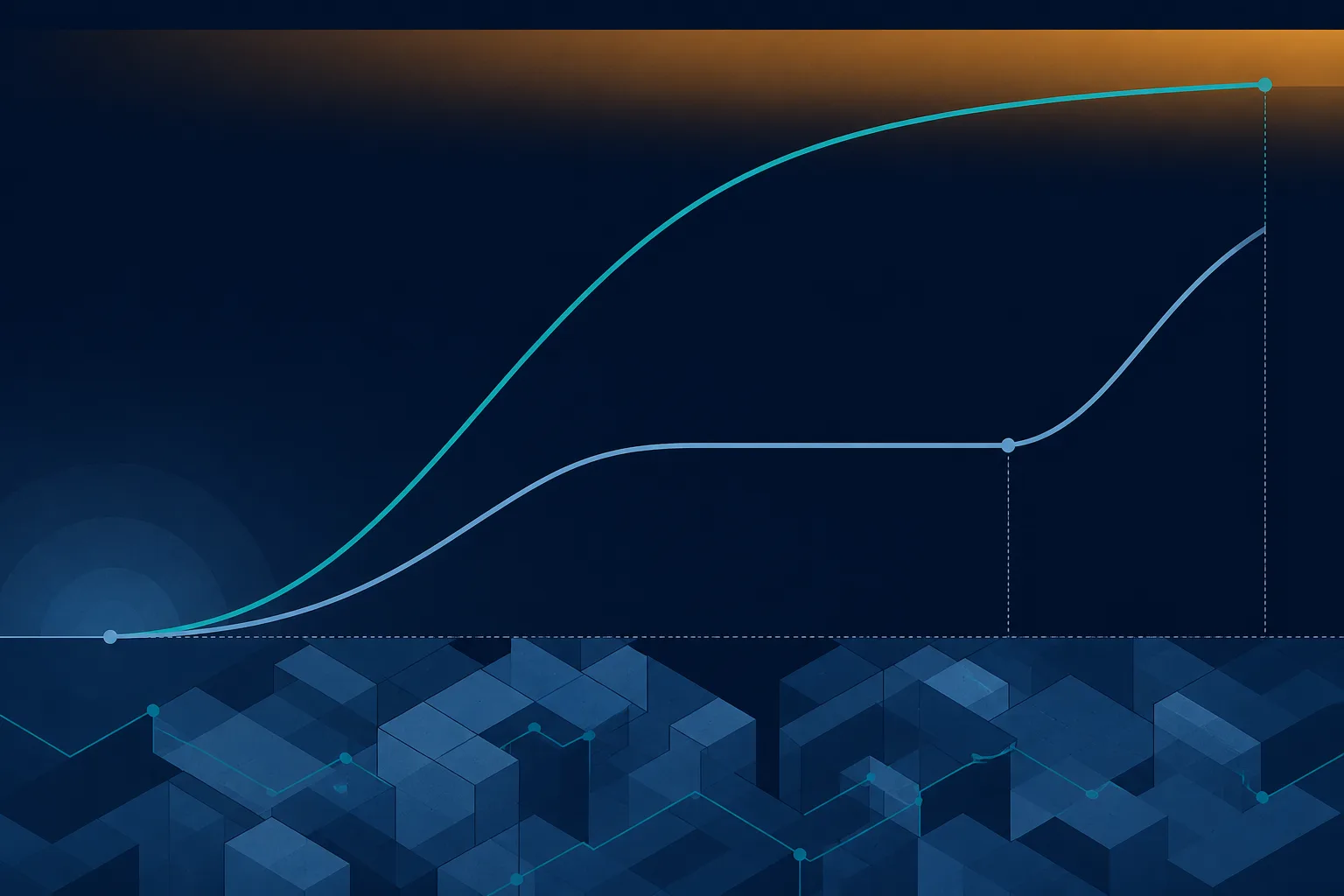
Why a full freezer coasts and an empty one does not
Treat the cabinet as a battery being discharged. Heat leaks in through walls and gasket at a rate set by the temperature difference between room and contents — that is the discharge current, changeable only by changing the envelope or the room. The stored charge is the thermal mass inside, and that is where the leverage sits: it is the one term you control completely, for almost nothing.
Air holds nearly nothing. Its specific heat is around 1 kJ per kilogram per kelvin and its density near 1.2 kg per cubic metre, so the air filling a 200-litre cabinet weighs roughly a quarter of a kilogram and stores a few hundred joules for every degree it warms. Water stores about 4.2 kJ per kilogram per kelvin, and melting a kilogram of ice absorbs roughly 334 kJ with no temperature change at all — the same energy as warming that kilogram of liquid water by eighty degrees. A cabinet with empty shelves is a cabinet with a flat battery in it, however good the insulation.
Which leads to the less obvious point: the temperature at which your mass changes phase matters more than how much of it there is. Plain water packs plateau at 0 °C. In a cabinet held near −20 °C the load has crossed every limit that matters long before those packs begin to melt, so the latent heat defends a temperature you already conceded. In a +2 °C to +8 °C unit the same packs sit below the lower limit and become a freezing hazard to what they touch.
This is why the engineering work on extending autonomy uses phase-change materials chosen to melt near the setpoint rather than at 0 °C. An experimental study of chest freezers using materials melting at −21 °C and −12 °C reported extending blackout autonomy by roughly 7 to 40 percent depending on configuration, alongside a 13 percent cut in daily energy use, and the authors note that the higher-melting variant suits regions with unstable grids while the lower-melting one is an efficiency play for stable ones [5]. Earlier work integrated latent-heat elements into household appliances and measured the result against the appliance standard's temperature-rise-time test rather than against a marketing claim [4]. The solar direct-drive design WHO documents for off-grid facilities takes the idea to its conclusion: store the energy as ice in an insulated bank inside the cabinet and dispense with the electrical battery entirely [8].
Measuring your own holdover time in one weekend
Published figures describe prequalified equipment tested to a written procedure. Yours is a unit standing in a specific room under a specific load, and the only defensible number is the one you measured. The test costs a logger and a weekend.
- Load the unit exactly as it normally runs, empty space included. If you intend to add mass, test without it first so a baseline exists.
- Place at least three sensors: the warmest point (usually top front, nearest the door), the geometric centre, and one probe inside a sealed vessel of water or glycol standing in for the load.
- Log room temperature on the same clock. A holdover figure without its ambient is unusable to anyone, including you in six months.
- Let everything stabilise for twenty-four hours at the normal running state before you touch anything.
- Disconnect at the wall rather than at the thermostat, note the exact time, and keep the door shut throughout.
- Stop the clock when the warmest air point crosses your written limit — then keep logging. The tail tells you how long a silent failure stays invisible.
- Repeat at the hottest ambient you can arrange: late afternoon in a hot week, not dawn in a cool one.
Read the curve, not only the endpoint. Warming is fastest in the first hour, because the difference between contents and room is largest when the contents are coldest, and the leak rate falls as the box warms. A two-hour interruption therefore does considerably more than half the damage of a four-hour one — the opposite of how most people budget outage risk. Any melting plateau in your load shows up as a flat section, and its temperature tells you whether the added mass is working at a useful level or a decorative one.
Be explicit about which sensor your limit refers to. Continuous monitoring guidance for cold storage specifies a buffered probe — embedded in glycol, glass beads or sand — so the record reflects the stored material rather than an air spike from a door opening [7]. That buffer is itself thermal mass, and it will always report a longer holdover than a bare air sensor in the same cabinet. Both readings are honest; only one can be the one your procedure names, and switching after the fact is how a record stops being evidence.
What actually buys hours, in order
| What you change | Physical effect | Order of magnitude | The catch |
|---|---|---|---|
| Fill empty volume with sealed water containers | Puts stored energy where only air was | Largest free gain in an under-loaded cabinet | Costs shelf space; slows recovery once supply returns |
| Match the melting plateau to the setpoint | Latent heat spent at a temperature you can live with | Prototype freezers: 7 to 40 percent more autonomy | Purpose-made material; plain water plateaus at 0 °C |
| Keep the door shut throughout | Removes the dominant heat path | Minutes to hours, depending on the opening | Requires a written rule people obey at 02:00 |
| Lower the room, clear the condenser | Shrinks the difference driving the leak | Compounds every other measure here | Room cooling depends on the same failed supply |
| Move material to a passive container with a published cold life | Swaps an unknown envelope for a measured one | Long-range carriers: thirty hours and beyond at +43 °C | Only works if packs are conditioned and staged in advance |
The last row deserves emphasis, because it is the option most often treated as an admission of defeat. WHO-prequalified long-range vaccine carriers publish measured cold lives in the thirty-to-forty-hour range at a constant +43 °C ambient, with listed models at 34 hours and at 39 hours 17 minutes [3]. A conditioned passive container with a third-party measured number will comfortably outlast a powered cabinet with an unknown one. Staging it in advance — packs conditioned, seal checked, a written trigger temperature for the transfer — is a real contingency; going to look for one during the outage is not. Cold-chain guidance makes the same point procedurally: the emergency plan should name the alternate location and state how quickly material must be relocated once a unit fails [7].
What thermal mass cannot fix
Adding mass is cheap and not free of consequence. The best-documented harm is freezing: a systematic review of cold-chain temperature studies found that between 14 and 35 percent of the refrigerators or shipments examined had exposed their contents to sub-zero temperatures, with un-conditioned frozen packs among the recognised routes [6], and for anything held in solution an unintended crossing of 0 °C is a freeze–thaw event with its own damage mechanisms rather than merely a moment outside a limit. Storage-and-handling guidance permits water containers for stability in some units but defers to the manufacturer's instructions and excludes them from many pharmaceutical-grade cabinets, where the airflow design assumes clear space [7]. "Fill the empty shelves" is sound physics and can still be the wrong instruction for a particular cabinet.
Three further limits are worth writing into the procedure rather than discovering at 02:00:
- Mass is symmetric. A heavily loaded cabinet warms slowly and pulls back down slowly; recovery lengthens by roughly the factor that extended the holdover, and the material spends that time out of limit too.
- Mass does nothing about restart behaviour, closely spaced interruptions, or a compressor that never comes back. Those are electrical and mechanical faults with electrical and mechanical answers.
- Mass hides failure. A well-loaded unit whose compressor died on Friday evening can still read inside limit on Saturday morning. Holdover is also the window in which a dead cabinet looks alive — the argument for an alarm keyed to elapsed time above limit rather than to a spot reading.
Where the numbers are solid and where they are not
Some of this is settled enough to write straight into a standard operating procedure. The definitions and their test conditions are published and unambiguous [1][2][3], the distinction between sensible and latent storage is uncontested textbook physics, and the cold-life figures on prequalified passive containers were measured by a third party against a stated procedure — more than can be said for most equipment claims [3].
What is thin is the transfer to your situation. Published holdover times describe purpose-built appliances; a domestic chest freezer in a storeroom has no equivalent figure, and although the appliance standard defines temperature rise time, manufacturers in most markets do not print it anywhere a buyer will see it [2]. The phase-change results come from a handful of prototypes tested with the door closed under standard conditions [4][5] — a working room with door traffic, a dust-blanketed condenser and a 36 °C afternoon is not that room, and nobody has published the correction between them. And no specification anywhere sets a holdover requirement for a laboratory freezer holding lyophilised research material, where the conditions such material is normally held under come from supplier documentation and convention rather than from a prequalification standard with a test procedure behind it. The vaccine documents are the nearest defensible analogue, borrowed rather than binding, and your records should say so plainly instead of implying they govern you.
One question is genuinely contested rather than merely unstudied: whether the limit should be defined on air temperature or on a buffered probe. Air-based endpoints are what the equipment specifications measure; buffered probes are what monitoring guidance recommends [1][7]. The two give materially different holdover times for the same cabinet, and no authority has reconciled them for material outside the vaccine cold chain. Choose one, put the choice in writing, and do not switch when the other answer is more convenient.
References
- PQS performance specification E003/RF03.5: Refrigerator or combined refrigerator and water-pack freezer, compression-cycleWorld Health Organization, Performance, Quality and Safety (PQS) prequalification programme, 2020
- IEC 62552-2:2015 Household refrigerating appliances — Characteristics and test methods — Part 2: Performance requirementsInternational Electrotechnical Commission, 2015
- PQS performance specification E004/CB01.3: Vaccine cold boxWorld Health Organization, Performance, Quality and Safety (PQS) prequalification programme
- Improving the performance of household refrigerating appliances through the integration of phase change materials in the context of the new global refrigerator standard IEC 62552:2015International Journal of Refrigeration, 2020
- Advancing Domestic Freezers With Phase Change Materials: Experimental Study Towards CommercializationHeat Transfer, 2025
- Freezing temperatures in the vaccine cold chain: a systematic literature reviewVaccine, 2007
- Vaccine Storage and Handling ToolkitUnited States Centers for Disease Control and Prevention, 2024
- Solar direct-drive vaccine refrigerators and freezers (WHO/IVB/17.01)World Health Organization, 2017
- General Chapter <659> Packaging and Storage RequirementsUnited States Pharmacopeia–National Formulary (USP–NF), 2020